Artificial Intelligence (AI) is changing the way businesses market their products and services. From social media management to customer support, AI has become an important part of digital marketing. Today, companies use AI tools to save time, improve customer experience, and increase sales. Digital marketing is no longer only about creativity; it is now a combination of creativity, technology, and data-driven decisions.
In simple words, AI refers to machines or software that can perform tasks that usually require human intelligence. These tasks include analyzing data, understanding customer behavior, creating content, predicting trends, and automating repetitive work. AI helps marketers make smarter decisions faster and more efficiently.
Importance of AI in Digital Marketing
The digital world is growing rapidly. Millions of users are active online every day on platforms like Instagram, Facebook, YouTube, LinkedIn, and Google. Managing such a huge audience manually is difficult. AI helps marketers understand customer interests, behavior, and preferences by analyzing large amounts of data.
AI also helps businesses provide personalized experiences. For example, when you search for products on an eCommerce website and later see similar ads on Instagram or Google, that is AI working behind the scenes. It studies your behavior and shows relevant content to increase the chances of purchase.
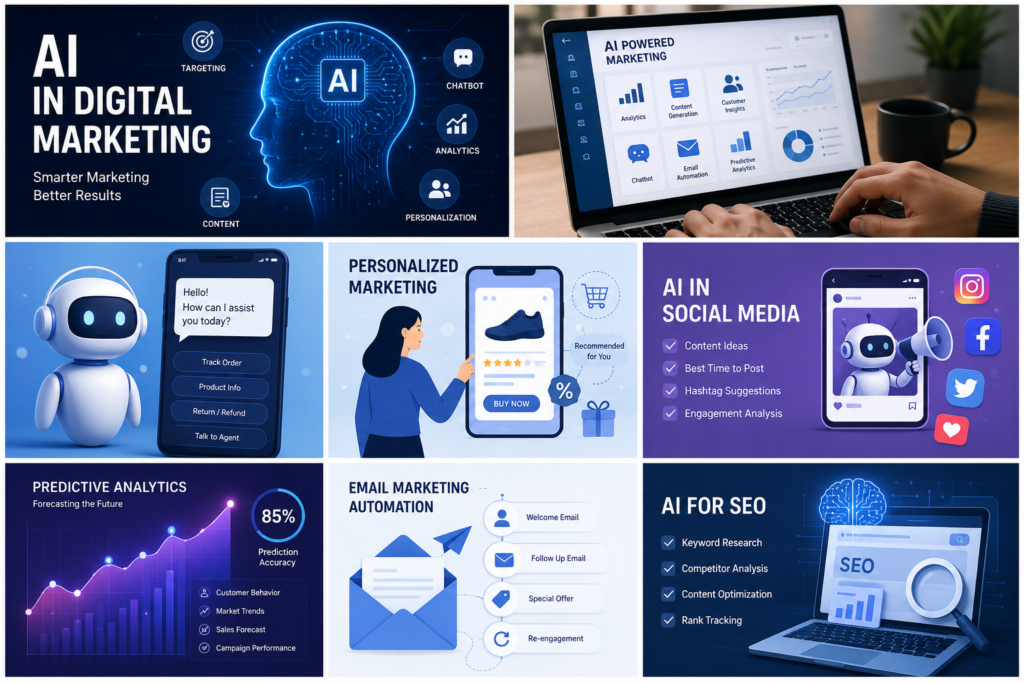
Applications of AI in Digital Marketing
1. Content Creation
AI tools can generate blog articles, captions, ad copies, email content, and video scripts within seconds. Tools like ChatGPT, Jasper AI, and Copy.ai help marketers create engaging content quickly. This saves time and improves productivity.
For example, a digital marketer can use AI to:
- Write Instagram captions
- Create YouTube video scripts
- Generate blog ideas
- Write email marketing campaigns
- Create ad headlines and descriptions
Although AI creates content faster, human creativity is still important for adding emotions, storytelling, and originality.
2. Chatbots and Customer Support
AI-powered chatbots are widely used on websites and social media platforms. These chatbots provide instant replies to customer queries 24/7. They improve customer experience and reduce the workload of support teams.
For example, if a customer asks about product pricing, delivery time, or refund policy, the chatbot can answer immediately without human involvement. This increases customer satisfaction and builds trust.
3. Personalized Marketing
AI helps businesses deliver personalized recommendations based on customer behavior. Platforms like Netflix, Amazon, and Spotify use AI algorithms to recommend movies, products, or songs according to user interests.
In digital marketing, personalization increases engagement and conversions. Customers are more likely to interact with content that matches their preferences.
4. Social Media Marketing
Managing social media accounts manually can be time-consuming. AI tools help marketers schedule posts, analyze engagement, suggest hashtags, and even generate content ideas.
AI also helps identify the best time to post content for maximum reach and engagement. Tools like Buffer, Hootsuite, and Meta Business Suite use AI-based insights to improve social media performance.
5. Email Marketing Automation
AI improves email marketing by analyzing user behavior and sending personalized emails automatically. It helps marketers understand:
- Which subject lines perform better
- Best time to send emails
- Customer interests
- Open rates and click-through rates
AI-driven email campaigns increase engagement and improve conversion rates.
6. SEO and Website Optimization
Search Engine Optimization (SEO) is essential for ranking websites on Google. AI tools help marketers find keywords, analyze competitors, optimize content, and improve website performance.
Tools like Surfer SEO, SEMrush, and Ahrefs use AI to provide keyword suggestions and SEO recommendations. AI can also analyze user behavior on websites and suggest improvements for better user experience.
7. Predictive Analytics
Predictive analytics uses AI to forecast future trends and customer behavior. Businesses can analyze past data to predict:
- Customer purchasing behavior
- Market trends
- Product demand
- Advertising performance
This helps companies make better marketing decisions and plan strategies effectively.
Benefits of AI in Digital Marketing
Saves Time
AI automates repetitive tasks such as scheduling posts, replying to messages, and analyzing reports. This allows marketers to focus on strategy and creativity.
Improves Efficiency
AI tools can process huge amounts of data within seconds, providing accurate insights and recommendations.
Better Customer Experience
AI provides personalized content and instant support, improving customer satisfaction.
Higher ROI
By targeting the right audience with personalized campaigns, businesses achieve better results and higher returns on investment.
Data-Driven Decisions
AI helps marketers make informed decisions using real-time analytics and customer insights.
Challenges of AI in Digital Marketing
Despite its advantages, AI also has some challenges.
Lack of Human Emotion
AI-generated content may sometimes sound robotic and lack emotional connection.
Data Privacy Concerns
AI collects and analyzes user data, which raises concerns about privacy and data security.
Dependency on Technology
Overusing AI can reduce human creativity and originality in marketing campaigns.
Learning and Adaptation
Businesses and marketers need proper training to understand and use AI tools effectively.
Future of AI in Digital Marketing
The future of AI in digital marketing is very promising. AI technology is continuously evolving and becoming more advanced. In the coming years, we may see:
- More advanced AI-generated videos and images
- Voice search optimization
- AI influencers and virtual creators
- Hyper-personalized marketing campaigns
- Smarter advertising systems
AI will continue to help businesses connect with customers more effectively and efficiently.
Conclusion
Artificial Intelligence has transformed digital marketing by making marketing faster, smarter, and more personalized. From content creation to customer support and predictive analytics, AI is helping businesses improve their marketing performance and customer experience.
However, AI should be used as a supportive tool rather than a complete replacement for human creativity. The best marketing strategies combine human ideas with AI technology. Businesses that adopt AI in digital marketing will have a competitive advantage in the future.
In today’s digital world, understanding and using AI is no longer optional—it has become essential for marketers and businesses who want to grow and succeed.